
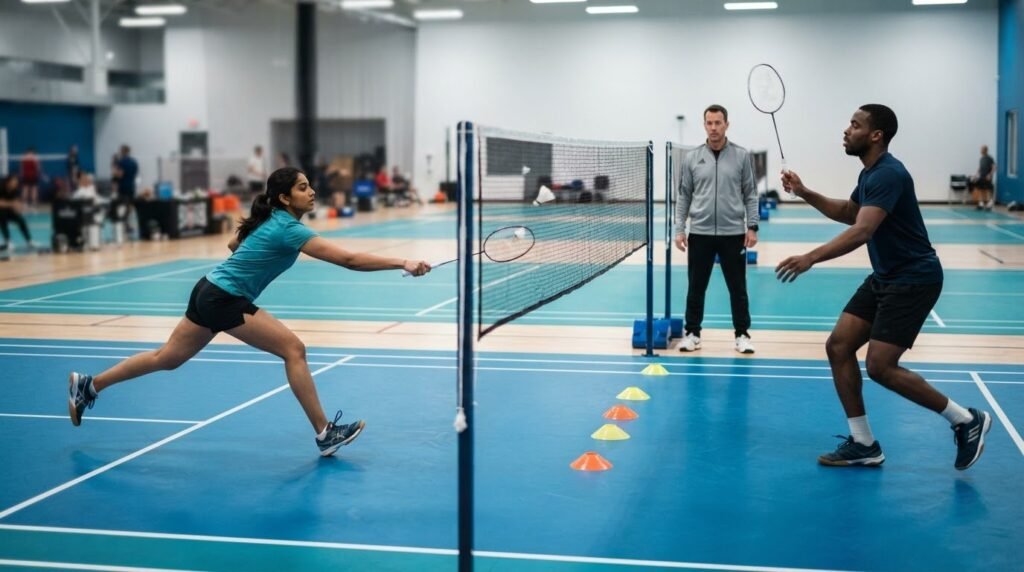
What if your next badminton session felt less like repeating shots and more like building a rally? If practice has started to feel repetitive, or your footwork fades as rallies get longer, you’re not alone. Badminton drills for intermediate players should connect movement, shot quality and decision-making, so each repetition prepares you for the next ball.
The right drills can help you move and recover with more purpose, keep shots consistent under pressure and make partner practice feel closer to real play. You don’t need a complicated routine. You need a clear focus and a way to notice your progress.
This guide brings together solo and partner drills to sharpen footwork, practise reliable clears, drops and net shots, and help you choose a response as play unfolds. You’ll also find ways to track each session, adjust the challenge and carry better habits into longer rallies. Whether you play in Brampton, Mississauga, Caledon or Milton, pick a drill, set a simple goal and make your next practice count.
Key Takeaways
- Choose badminton drills for intermediate players that connect footwork, shot quality and decisions, rather than repeating shots without a clear goal.
- Build practice in stages: warm up, work on movement, add shots, then practise choosing responses.
- Use solo drills to rehearse movement patterns, partner drills for shot timing and feedback, and game-based practice to apply skills under pressure.
- Give each drill a target, work period and reset so you can track progress and keep practice focused.
- Use regular court practice to repeat drills, and consider professional coaching for individualized feedback on technique and progress.
Badminton drills for intermediate players: what should practice improve?
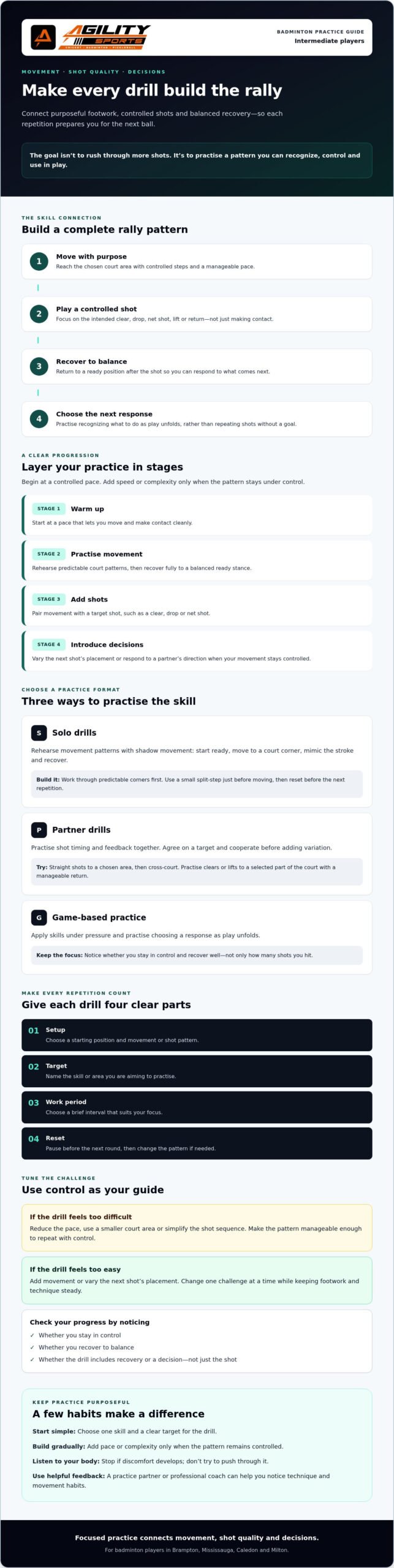
At an intermediate level, practice needs to connect skills that can otherwise stay separate. A clear or drop shot is only part of the rally. You also need to move into position, play with control, recover your balance and choose what to do next. A drill with one clear purpose helps you practise those connections more effectively than a string of random repetitions.
A productive intermediate badminton drill links purposeful movement with a controlled shot and balanced recovery, then gives you a chance to repeat the pattern with focus. For example, move to the rear court to play a clear, then recover to a ready position before starting again. The goal isn’t to rush through as many shots as possible. It’s to build a pattern you can recognize and use in play.
If you want a refresher on the sport’s basic rules and history, see Badminton. For your practice, keep the focus narrower: choose one skill to improve and use the drill to work on it. Progress comes from focused repetitions, useful feedback and a challenge that’s demanding but manageable. A coach or practice partner can help you spot movement or technique habits that are hard to notice on your own.
How do you know a drill is right for your level?
A suitable drill challenges your control without turning every repetition into a scramble. If you’re frequently off balance or unable to make the intended shot, reduce the pace, use a smaller court area or simplify the shot sequence. If the pattern feels too easy, add movement or vary the next shot’s placement. Track how often you stay in control and recover well, not just how many shots you hit.
Why link footwork, shots, and recovery?
After a shot, returning to a balanced ready position helps you respond to what comes next. Practise movement patterns that reflect common rallies, such as moving between the rear court and the net, rather than treating footwork as separate from hitting. Keep your steps controlled and choose a manageable pace. Stop if discomfort develops, and don’t try to push through it.
Before you begin any drill, ask: What skill is it targeting? Can you repeat it with control? Does it include recovery or a decision, not just the shot itself? Clear answers make badminton drills for intermediate players purposeful and give each session a focus you can check again next time.
Build better movement and shot control with a clear drill progression
Build your session in layers: warm up, practise movement, add shots, then introduce decisions. Start at a controlled pace so you can repeat the movement and contact cleanly. Increase speed or complexity only when the pattern stays under control. Progress a drill by changing one challenge at a time while keeping your footwork and shot technique steady.
Give each drill four simple parts: a setup, a target, a work period and a reset. Choose a brief interval that suits your focus, then pause before the next round. For example, set a target area for a clear, move into position with balance, play the shot, then return to ready before repeating. If your control slips, simplify the pattern rather than pushing through rushed repetitions. These badminton drills for intermediate players should challenge you while still leaving room to practise well.
Which footwork drills help you recover between shots?
Start with shadow movement. From the ready position, move to a selected court corner, mimic the stroke and recover to a balanced ready stance. Use a small split-step just before you move, then reset fully before the next repetition. Work through predictable corners first. Once your movement stays controlled, ask a partner to call directions. Keep the pace manageable and stop if discomfort develops.
- Setup: Begin in the ready position and choose one corner or movement pattern.
- Target: Move with control, simulate the shot and recover to balance.
- Work and reset: Repeat during a brief, agreed interval, then pause and reset before changing the pattern.
How can you improve consistency with a partner?
Make the first goal cooperation, not winning the rally. Agree to hit straight shots to a chosen area, then repeat cross-court. Next, practise clears or lifts to a selected part of the court while your partner returns a manageable shot. Keep the pace steady before adding variation or asking your partner to change the placement. For further coaching ideas, explore the Badminton World Federation’s BWF coaching resources.
- Setup: Choose a shot pattern and target area together.
- Target: Keep the shuttle in the agreed area while staying balanced and recovering after each shot.
- Work and reset: Rally for a brief interval, pause, then switch roles or adjust the target.
Keep partner feedback concise. Note whether your balance, contact point or recovery needs attention. Change one thing at a time, then see whether the rally remains controlled. To repeat these progressions on court, explore badminton court rental at Agility Sports in Brampton.
Which badminton drills should you choose: solo, partner, or game-based?
Choose a practice format based on what you want to improve and who’s available. Solo work lets you focus without waiting for a partner. Cooperative rallies add shuttle timing and shared feedback. Conditioned games test whether you can use a skill while making choices. A useful session can move through all three, but each format has a different job.
- Practising alone: Rehearse movement patterns and your pre-shot routine. You control the pace, but there’s no live shuttle to test timing.
- With a partner: Build rally control and placement through cooperative exchanges. Your partner can respond to your shots and offer another perspective.
- In a conditioned game: Apply a chosen skill while reacting to a changing rally. A simple rule, such as rewarding a successful target shot, keeps the game connected to your focus.
When should you practise alone?
Use solo shadow work when you want to rehearse footwork without a shuttlecock. Move through a familiar pattern, follow the same pre-shot routine each time and finish balanced in your ready position. Keep repetitions controlled and notice whether the sequence feels consistent. Solo work helps you practise movement, but it can’t reproduce a shuttle’s timing or replace rally practice.
For a useful progression, move from rehearsal to interaction: practise the pattern alone, try it in a cooperative exchange, then test it with a game constraint. For broader context on coach development, see USA Badminton coaching programs, which discusses the adoption of BWF coach certification programs.
When do partner and game-based drills work best?
Partner drills suit goals that need a real exchange. Rally cooperatively to build length and placement, then add one rule, such as aiming cross-court or moving forward after a lift. Once the target becomes familiar, play a short conditioned game that rewards using it. Keep the rule simple enough that you can focus on the skill, not just the score.
Use this quick match-up to choose among badminton drills for intermediate players:
- Want to rehearse movement and have no partner? Choose solo shadow practice.
- Want to improve controlled placement with a partner? Choose a cooperative rally with one target.
- Want to practise decisions under pressure? Choose a conditioned game linked to that session’s skill.
For players in Brampton, Mississauga, Caledon and Milton, badminton court rental at Agility Sports in Brampton offers indoor court time for partner practice and game-based drills.
How to plan a badminton practice session that shows progress
A useful session has a clear thread from warm-up to play. Pick one movement goal and one related shot goal, then finish by testing both in a rally or short game. This gives badminton drills for intermediate players a practical purpose: each activity prepares you for the next instead of leaving you with disconnected repetitions.
What should an intermediate practice plan include?
Start with movement-focused warm-up activities, then build rally intensity gradually. Pair a footwork focus, such as recovering after moving to the rear court, with a shot-control focus that fits the pattern, such as playing a clear towards a chosen area. Close with a short game or conditioned rally where you try to use that movement and shot naturally.
Before each activity, decide how long you’ll work and how much rest you’ll take. Choose intervals that let you keep your technique controlled, and adjust them if you’re tiring or losing focus. Between rounds, pause long enough to reset and note what happened. There’s no single work-to-rest schedule that suits every player or session.
- Warm-up: Prepare to move, then gradually raise the pace.
- Movement goal: Focus on one movement or recovery habit.
- Shot goal: Connect that movement to a specific shot and target.
- Game application: Test the focus in a rally or short game.
How can you adapt drills as your control improves?
Record simple observations after each drill: how often you kept control, whether you returned to a balanced position and whether you chose the intended shot. A few brief notes make it easier to compare sessions and decide what to work on next. Look for steadier execution, not instant transformation.
When a drill feels manageable, change one variable at a time. You could extend the movement range, add another shot option or ask a partner to vary the feed. Keeping the other parts steady helps you see how the change affects your control. If your balance or technique becomes inconsistent, return to the simpler version before progressing again.
Consistent indoor practice gives you a place to revisit the same goals and observe how they develop. For more on planning court time in the area, read this guide to badminton court rental in Brampton. You can also book badminton court time to put your practice plan into action.
Take your intermediate badminton drills onto the court with coaching support
Good practice needs room to repeat a movement, try a shot and see how it fits into a rally. Regular court time makes it easier to return to the same training focus across sessions and notice where your control or recovery changes. For players working through badminton drills for intermediate players, consistency is more useful than trying a new pattern every time you play.
What can a coach add to your practice?
A coach can offer another set of eyes on your movement, shot choices and technique. That feedback may help you spot a habit you haven’t noticed or adjust a drill when it no longer matches your goal. Bring a clear question, such as whether you’re recovering well after a shot or choosing an effective response in a rally. Ask whether the available coaching suits your current level and priorities, as options can vary.
Agility Badminton Academy provides structured badminton training, and professional coaching is an option for players looking for technique feedback. Coaching can support your practice, but progress still depends on the work you put in and the goals you choose. Keep a few notes from your sessions so you can explain what you’re working on and make feedback more relevant to your next practice.
Where can you practise badminton in Brampton?
Agility Sports is an indoor multi-sport facility in Brampton offering badminton court rentals. Court time gives you a place to repeat movement and rally drills with a partner and apply them in play. If you’re practising independently, bring a simple session focus. If you’re playing with someone, agree on what you want to work on before you start.
Players in Brampton, Mississauga, Caledon and Milton can explore indoor court time in Brampton and choose a practice focus before they arrive.
Make your next badminton session count
Choose badminton drills for intermediate players with one clear purpose, then build from controlled movement and shot practice towards rally decisions. Keep track of your balance, recovery and shot choices so you can adjust the challenge with intention. Small, focused changes give each session direction.
Agility Sports offers badminton court rental in Brampton, with professional coaching available through Agility Badminton Academy for players seeking feedback on technique and progress. Use the FAQ below to choose a drill focus, then explore the court and coaching options that fit your goals.
Frequently Asked Questions
What are the best badminton drills for intermediate players?
The best badminton drills for intermediate players connect movement, shot control and recovery. Choose drills that match a goal, such as moving to the rear court, playing a controlled clear and returning to a balanced position. Practise the pattern at a manageable pace before adding shot variation or pressure. A partner drill or conditioned game can then help you apply the skill while responding to a changing rally.
How can I practise badminton footwork by myself?
Practise footwork with shadow movement: start in a ready position, move to a chosen court area as if reaching for a shot, then return to balance. Use a split-step cue before moving and repeat the sequence at a controlled pace. You can follow a consistent pre-shot routine, too. Without a shuttle or partner, this work rehearses movement, but it won’t reproduce the timing of a live rally.
How do you improve consistency in badminton rallies?
Improve rally consistency by agreeing on a simple cooperative target with your partner, such as keeping straight shots in a chosen area. Focus on controlled contact, balanced movement and recovery after each shot rather than hitting harder. If the rally breaks down, slow the pace or simplify the shot pattern. Keep a brief note of what stayed consistent so you can choose a clear focus for your next practice.
Can I practise badminton drills without a partner?
Yes. Solo shadow drills let you rehearse footwork, recovery and your ready position without a partner or shuttlecock. Choose a movement pattern, complete it with control, then reset before repeating. Solo practice is useful for building familiarity with movement, but it can’t provide a live shuttle’s timing, partner feedback or changing rally decisions. Add partner or game-based practice when you want to test those skills in play.
How often should intermediate players practise badminton?
There’s no single practice frequency that suits every intermediate player. Choose a schedule that fits your routine and lets you practise with focus while allowing time to recover. Keep sessions purposeful by selecting a movement goal and a shot goal, then note what you’d like to revisit. If your technique or balance becomes less controlled, adjust the session rather than forcing more repetitions.
What drills help improve badminton shot selection?
Partner drills and conditioned games are useful for practising shot selection because they require you to respond to another player’s shot. Start with a cooperative rally and agree to vary placement, such as alternating between a clear and a drop when the opportunity suits. Then play with a simple rule that rewards a chosen shot or target. Review whether your choices kept you balanced and ready for the reply.
Where can I practise badminton in Brampton?
Agility Sports is an indoor multi-sport facility in Brampton that offers badminton court rentals. Players in Brampton, Mississauga, Caledon and Milton can explore court time for repeating drills and practising rallies. Agility Badminton Academy provides structured badminton training, and professional coaching is available as an option for technique feedback. Check with the facility about current coaching options to see what fits your goals.
Ready to put your practice plan to work? Explore badminton court rental and coaching options at Agility Sports in Brampton.